Twenty-five years building the systems that move governments and enterprises
I am a digital transformation expert and advisor based across the GCC. My practice covers governance, AI adoption, enterprise architecture, project portfolios, and the institutional design that makes the rest of it stick. I write, I advise, I build, and I teach.
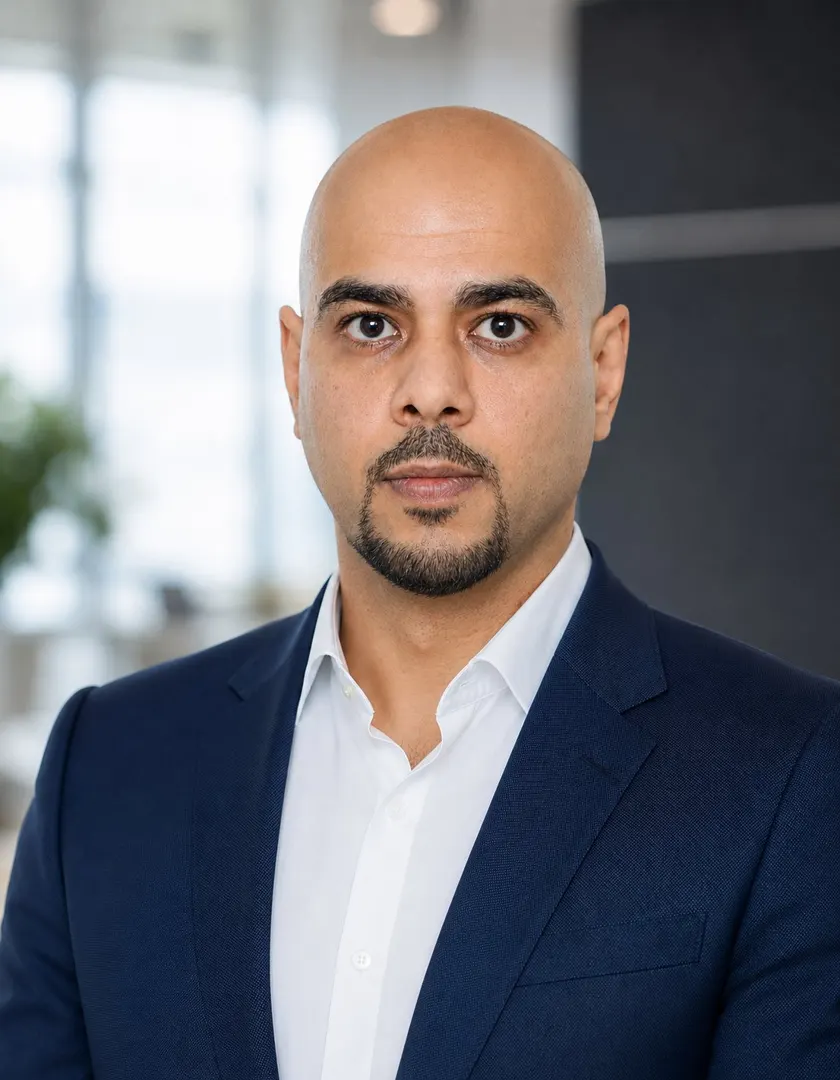
Twenty-five years of practice across the Gulf — UAE, Saudi Arabia, Qatar, Turkey, Jordan. My work covers AI adoption, IT governance, enterprise architecture, project portfolios, and the institutional design that makes the rest of it stick.
I take on work where the problem is not what to buy, but how to make the organisation capable of using what it already has. My clients have included federal authorities, holding groups, hospitality portfolios, and property operators at national scale. I'm a graduate of Harvard Business School's Disruptive Strategy programme, and I hold fifteen certifications including PMP, CISSP, CISA, COBIT 2019, and ITIL.
I believe that institutional architecture is the missing half of digital transformation; that AI adoption is governance work; that GCC AI capability must be built Arabic-first; and that all three are national-capability work, not vendor work. I write regularly under Insights, advise both private-sector boards and public-sector entities, and am building a practical Arabic-first AI training programme at Academy.
What I believe about digital transformation in the GCC
Most digital transformation programmes fail not because the technology was wrong, but because the institutional architecture behind them was never built.
Twenty-five years across the GCC have taught me this is the rule, not the exception. The board approves the budget. The vendor wins the procurement. The platform deploys on time. Eighteen months later the dashboards exist but no one looks at them, the data pipeline runs but the underlying decisions are still made on intuition, and the AI pilot succeeded so completely that no one can explain why the rollout stalled. The technology worked. The institution didn't.
The half that gets skipped is the slower, less photogenic half — governance frameworks, decision rights, accountability structures, the operating model that connects intent to action. Without that scaffolding, every new technology lands on people who cannot, or will not, use it.
This is especially true for AI. AI adoption is governance work, not a procurement decision. Pilots succeed because they are bounded; rollouts fail because they are not. The organisations that scale AI are the ones that treated it as institutional design from day one — who answered, before buying anything, who decides what an AI system is allowed to recommend, who is accountable when it is wrong, how its outputs are audited, and how the human work changes around it. The procurement bill is the smallest line item in that conversation.
In the GCC the next decade will not be won by buying more software. It will be won by the institutions that learn to govern intelligence — human, machine, and the orchestration of both — at national scale.
That governance has to be local. AI tooling and training in this region cannot be translated in from elsewhere. Translated content reads foreign even when the words are Arabic; the vocabulary is wrong, the examples come from American small businesses, the regulations from European jurisdictions, the case studies from companies that never operated under GCC procurement rules. Arabic-first design is not a nicety. It is a competitive prerequisite. The Gulf is large enough, fast-moving enough, and culturally specific enough to require its own institutional architecture for AI — and small enough that the next decade will reward the people who build it first.
This work is national-capability work, not vendor work. Public-sector and private-sector clients face the same fundamental problem: the technology is ahead of the institutions that have to absorb it. Closing that gap is the most consequential work in the region right now. It is also the work I have spent twenty-five years preparing to do.
That is what this practice is for. Governance designed to outlast its sponsor. AI adoption disciplined enough to survive scaling. Arabic-first capability building. And the institutional architecture that makes all three hold.
Where the practice has been
- 2025
Confidential assignment
Head of Digital Transformation & AI for a confidential transformation assignment.
- 2024
Overmind Digital, Dubai
Chief Product Officer and Principal Consultant; trained government agencies on product development, AI adoption, and digital transformation delivery.
- 2022
zaer, US
CTO for customer engagement and experience products; built IoT-integrated, AI-powered product architecture and roadmap.
- 2021
Juma Al-Majid Group, Dubai
IT Manager for real-estate verticals; directed digital transformation across development, property management, facilities management, and hospitality.
- 2017
Belhasa International, Dubai
Led IT operations and security for real estate and driving education businesses, including fleet management, compliance, and data initiatives.
- 2014
POM | Sinyar | ZMS Holdings, Abu Dhabi
Group IT Manager; established digital governance, Dynamics 365 and facilities-management platforms, and infrastructure for 1,500+ users.
- 2011
Magnolia RM Investment, GCC
Group IT Manager for a regional restaurant investor and operator; led ERP, BI, contact-centre, Azure, and internal portal initiatives across five countries.
- 2009
Belhasa International, Dubai
IT Operations & Security Manager; strengthened compliance, restructured connectivity across 50+ locations, and improved service availability.
- 2006
Belle Vue Hotels, Jordan & UAE
IT Manager for a regional dry-hotel operator; implemented 25+ business and technical services and a 24/7 service desk.
- 2004
Movenpick Hotels, Jordan
IT Manager for the Dead Sea and Petra properties; rebuilt hotel infrastructure and supported the PETRA Conference of Nobel Laureates.
- 2002
Software Developer & Trainer
Started as a software developer and trainer, building technical systems and teaching practical implementation skills.
Awards
- 2016 - 2017
CIO 100
Magazine by Tahawultech
- 2017
CISO 100
Middle East Security Awards
- 2008 - 2017
Outstanding Contribution
Various Clients
- 2013 - 2014
Best Service Provider
Road and Transport Authority
- 2013
IT Department of the Year
Arab Computer News
- 2016
Measuring Success
CIO SpotLight by Tahawultech